
English| USD
Suggested for you
More currencies
Choose a language
Crossing from the Emirates into the Sultanate is one of the shortest international road journeys in the Gulf, yet the money side confuses first-timers more than the driving does. The advertised seat price is only part of the picture, because immigration counters on both sides collect their own charges. This dubai to muscat transfer cost guide sets out what is fixed, what is variable, and what is collected in cash on the day.
Quick answer
A scheduled coach seat from Deira to Muscat is priced at 100 AED per person, one-way, and that figure excludes mandatory exit fees collected at the frontier. Departures run daily between 06:00 and 22:00. Private cars, fuel, tolls and insurance sit outside that fare entirely, so budget separately for road charges and any vehicle documentation the crossing requires.
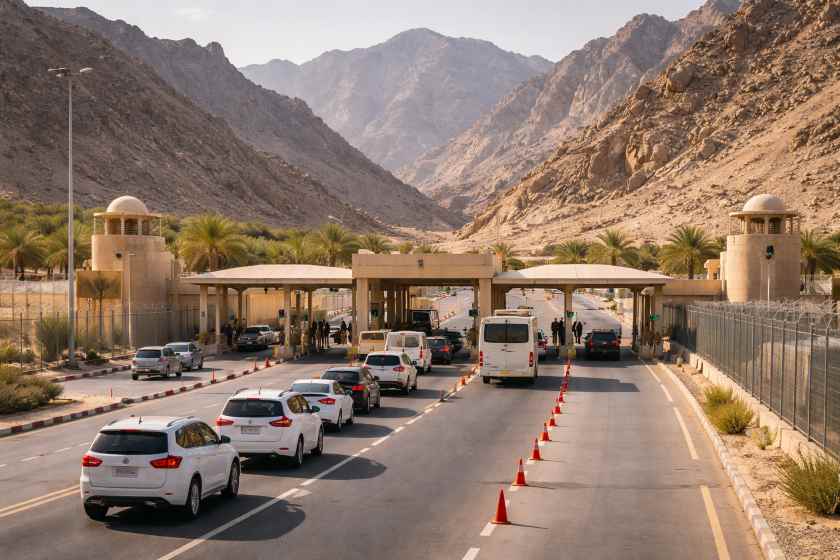
The road between the two cities is barely 400 kilometres, but a traveller can spend more time at passport control than on the motorway itself — which is precisely why the dubai to muscat transfer cost is never a single number. The journey passes through two sovereign jurisdictions, and each one levies its own charges at its own counter, in its own currency, at the moment of crossing rather than at the moment of booking. The first thing to understand is the split between the seat and the frontier. A coach fare covers the vehicle, the driver and the road; it does not cover immigration. Exit formalities on the Emirati side are collected separately and in person, and the Omani side applies its own entry conditions depending on nationality and residency status. Travellers holding UAE residence visas are treated differently from tourists arriving on a short-stay stamp, and the difference shows up as a real figure at the desk. Anyone comparing a Dubai Muscat transfer price against a flight ticket should therefore compare like with like: the airfare is all-inclusive, the road fare is not. Driving privately introduces a second set of variables. Salik gantries on Sheikh Zayed Road register automatically for UAE-plated vehicles, and rental agreements usually pass those charges back with an administration surcharge. Cross-border insurance — the orange card or an equivalent endorsement — must be arranged before departure, not at the barrier. Fuel is cheaper on the Omani side, so drivers commonly cross with a low tank and fill after the checkpoint. Add a vehicle permit, and the arithmetic for a solo traveller rarely beats a scheduled coach. Congestion is the hidden cost that no price list shows. Thursday evenings, Friday mornings and the tail end of public holidays turn the Hatta and Al Wajajah checkpoints into multi-hour queues, and a delayed arrival in Ruwi or Al Khuwair can mean an extra hotel night that dwarfs the saving on the fare. Departing during daylight, well before the late-evening rush, is the single most effective way to keep the total spend predictable. Read the practical dubai to muscat transfer cost breakdown on the pricing and checklist pages, confirm what your passport requires, and treat the border charges as a fixed part of the journey rather than an afterthought discovered at the window.
“The airfare is all-inclusive; the road fare is not — the border collects its share separately.”
The cost of a transfer from Dubai to Muscat depends primarily on the official bus ticket fee set by the operator. Travelers should also account for mandatory border crossing expenses which are separate from transport costs.
Verdict: A typical adult pays 100 AED for the bus ticket, with the final total varying based on personal visa fees and mandatory government border charges.
The primary departure point for cross-border transport to Muscat is situated behind the Dnata Building in Deira, Dubai. Travelers should plan for additional transit costs to reach this terminal as they are separate from the long-distance coach fare.
Red Line to Deira City Centre Station
Direct to Behind Dnata Building, Deira
Via E11 (Sheikh Zayed Road)
Arrive at the terminal between 06:00–21:00 to avoid peak border crossing congestion and ensure sufficient time for immigration formalities. Passengers are advised to reach the Al Khanjry station well before their scheduled departure.
The transfer service operates on a consistent daily schedule throughout the week to facilitate travel between Dubai and Muscat. Planning your departure according to these hours ensures access to available transport connections.
To manage transfer costs effectively, plan your journey within the best arrival window of 06:00–21:00. Arriving during this period helps avoid peak border congestion and minimizes potential delays that can lead to unforeseen travel time costs.
—
Reduced border traffic leads to faster processing times and lower risk of cumulative delays.
Mild, 20°C–30°C
Cooler temperatures make the long-distance road transfer more comfortable for passengers.
Hot, 30°C–40°C
Increased travel volume during shoulder months requires strict adherence to the recommended arrival window for efficiency.
Verdict: For the most efficient transit, aim for a weekday arrival between 06:00 and 09:00 during the cooler months of November to March.
Border formalities, not the fare, cause most delays on this route, so sort documents and cash before departure day.
Everything you need to know about dubai to muscat transfer cost
The current entrance fee for the bus is 100 AED per person for a one-way trip. Please note that this dubai to muscat transfer cost excludes mandatory exit fees payable at the border.
No, the bus ticket price only covers the seat. Travelers must be prepared to pay separate mandatory exit fees when crossing the border between the United Arab Emirates and Oman.
Yes, all passengers must carry a valid passport and an appropriate visa for Oman to complete the journey. Requirements can change, so verify your entry status before departure to avoid issues with immigration formalities.
To ensure a smooth journey, the best arrival window is between 06:00 and 21:00. This helps avoid peak border crossing congestion and provides sufficient time for necessary travel procedures.
The service departs from behind the Dnata Building in Deira, Dubai. This central location serves as the primary hub for the Dubai to Muscat bus route.
Yes, you can manage your bookings through the official website at https://alkhanjryonline.com. This platform provides the most accurate information regarding current schedules and transit policies.
The service operates daily from Monday through Sunday. You can find the coaches running between 06:00 and 22:00 throughout the entire week.
Passengers should confirm luggage limits directly with the operator to ensure compliance with vehicle storage capacity. Keeping baggage within reasonable weight and size limits is essential for international road transport.
Muscat Airport Private Transfer
Read more GuideCan You Drive From Dubai to Muscat?
Read more GuideDistance and Safety Guide
Read more Tickets & toursMuscat to Dubai Transfer
Read more GuideHow to Get from Dubai to Muscat
Read more Tickets & toursPrivate Taxi & Car Service
Read more