
English| USD
Suggested for you
More currencies
Choose a language
The road exists, the tarmac is good, and the mountains between the two cities are genuinely worth the windscreen time. What stops most travellers is not the driving — it is a rental agreement, an insurance certificate, or a queue at a barrier that opens onto another country. This page sets out the hurdles in the order you will meet them.
Quick answer
Yes. The most common route runs through the Hatta-Al Wajajah Border Crossing on the E44, which operates 00:00–23:59 every day of the week, with a 35 AED UAE land exit fee per person. The catch is the vehicle, not the road: most Dubai rental agreements exclude Oman entirely, and standard UAE motor insurance stops at the border.
The barrier at Al Wajajah never closes. That is unusual for a land frontier in the region, and it quietly reshapes how people plan the journey — the question is rarely whether the road is open, but whether the car in the driveway is legally allowed through it. Can you drive from Dubai to Muscat? The road answers yes; the paperwork answers it more slowly. The route leaves Dubai on the E44 towards Hatta, climbing out of the sand flats into the Hajar Mountains before the checkpoint at Hatta-Al Wajajah. From there the tarmac continues through Oman's interior towards Sohar and down the Batinah coast to Muscat. It is a straightforward drive on well-surfaced roads. The complications sit inside the glovebox. Rental companies in Dubai almost universally write Oman out of the standard contract; the vehicle is registered, insured and tracked for use inside the UAE only, and crossing without written consent voids the cover and can trigger a penalty on return. Where a rental firm does permit it, they issue a separate cross-border authorisation letter and an Orange Card — the regional green-card equivalent — usually for an added daily fee arranged days in advance, not at the counter on departure morning. Drivers of private vehicles face a parallel problem: UAE comprehensive policies stop at the frontier, and an Oman extension must be bought before travel. Leased and financed cars need a no-objection letter from the bank. Muscat road trip planning therefore starts with the vehicle, not the map. Anyone weighing whether a Dubai to Oman drive is worth the administrative load should price the alternative honestly — a pre-cleared private transfer removes the authorisation letter, the Orange Card, the deposit hold and the return-leg inspection in one decision, and the driver already knows which lane at the checkpoint moves. For those set on self-driving, the practical sequence is: confirm in writing that the vehicle may leave the UAE, extend the insurance to cover Oman, and only then think about departure times. The scenic payoff is real. The stretch through the Hajar foothills, the wadis east of Hatta and the long coastal run into the capital reward daylight driving. But the mountain sections are unlit, fuel stops thin out between the border and Sohar, and mobile coverage dips in the passes. So: can you drive from Dubai to Muscat? Yes, provided the car is cleared to go with you.
“The road answers yes; the paperwork answers it more slowly.”
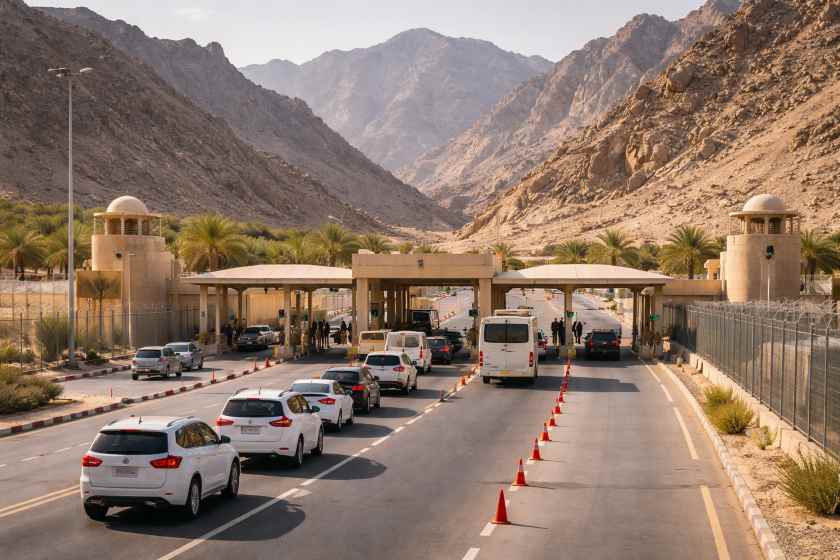
Driving from Dubai to Muscat requires navigating the Hatta-Al Wajajah Border Crossing, which is the primary land link for private vehicles between the UAE and Oman. Travelers utilizing this route must ensure their vehicle documentation is prepared for international transit.
E44 Road to Hatta-Al Wajajah Border
Private transfer via E44 route
For those driving a rental car, verify with your provider that international insurance coverage and a No Objection Certificate (NOC) for Oman are secured before departure. Aim to arrive at the border between 07:00–18:00 to ensure smoother processing and sufficient daylight for the journey.
Planning your trip between 07:00–18:00 is essential to ensure you navigate the border with optimal visibility and avoid peak congestion periods. This window provides the best conditions for a safe, daylight drive through the varying terrain between Dubai and Muscat.
Mild, 20°C–28°C
This season offers the most comfortable temperatures for long-distance driving and outdoor stops.
Warm, 30°C–35°C
Shoulder months remain manageable for travel, though afternoon temperatures begin to rise significantly.
Hot, 38°C–45°C
High heat requires reliable vehicle air conditioning and careful monitoring of engine temperatures during the journey.
—
Mid-week travel significantly reduces wait times at the Hatta-Al Wajajah Border Crossing compared to weekends.
Verdict: The best time to cross is Tuesday to Thursday between 07:00–10:00 during the cooler months of November to March.
Border officers check paperwork before anything else, so assemble these documents in the weeks leading up to your drive.
The Hatta-Al Wajajah border crossing operates on a continuous schedule, remaining accessible to travelers throughout the week.
Everything you need to know about can you drive from dubai to muscat
While many visitors wonder if you can drive from dubai to muscat using a rental car, most standard UAE rental agreements prohibit crossing international borders. You must secure specific cross-border insurance documentation from your rental agency before attempting the journey.
To cross the border, you need your passport, a valid Omani visa, and the original vehicle registration card. Additionally, you must carry a 'No Objection Certificate' provided by the rental company explicitly authorizing the vehicle for transit.
The Hatta-Al Wajajah border crossing is the standard route for this journey. Ensure your paperwork is organized to facilitate a smooth transit through the passport control and customs checkpoint.
Yes, there is a 35 AED UAE land exit fee per person required at the border. You should prepare this amount in advance to avoid delays during your international transit.
The best arrival window is 07:00–18:00 to avoid peak holiday traffic and ensure you have sufficient daylight for the drive. Navigating the mountain terrain is significantly safer and more comfortable during these hours.
To avoid complex insurance requirements, many travelers choose a private transfer service. This option removes the need for cross-border vehicle permits and allows you to enjoy the scenery without the stress of managing international coverage.
Before finalizing your plans, confirm that your vehicle rental company permits international travel. Failing to obtain the correct clearance can lead to insurance invalidation and significant legal issues at the border.